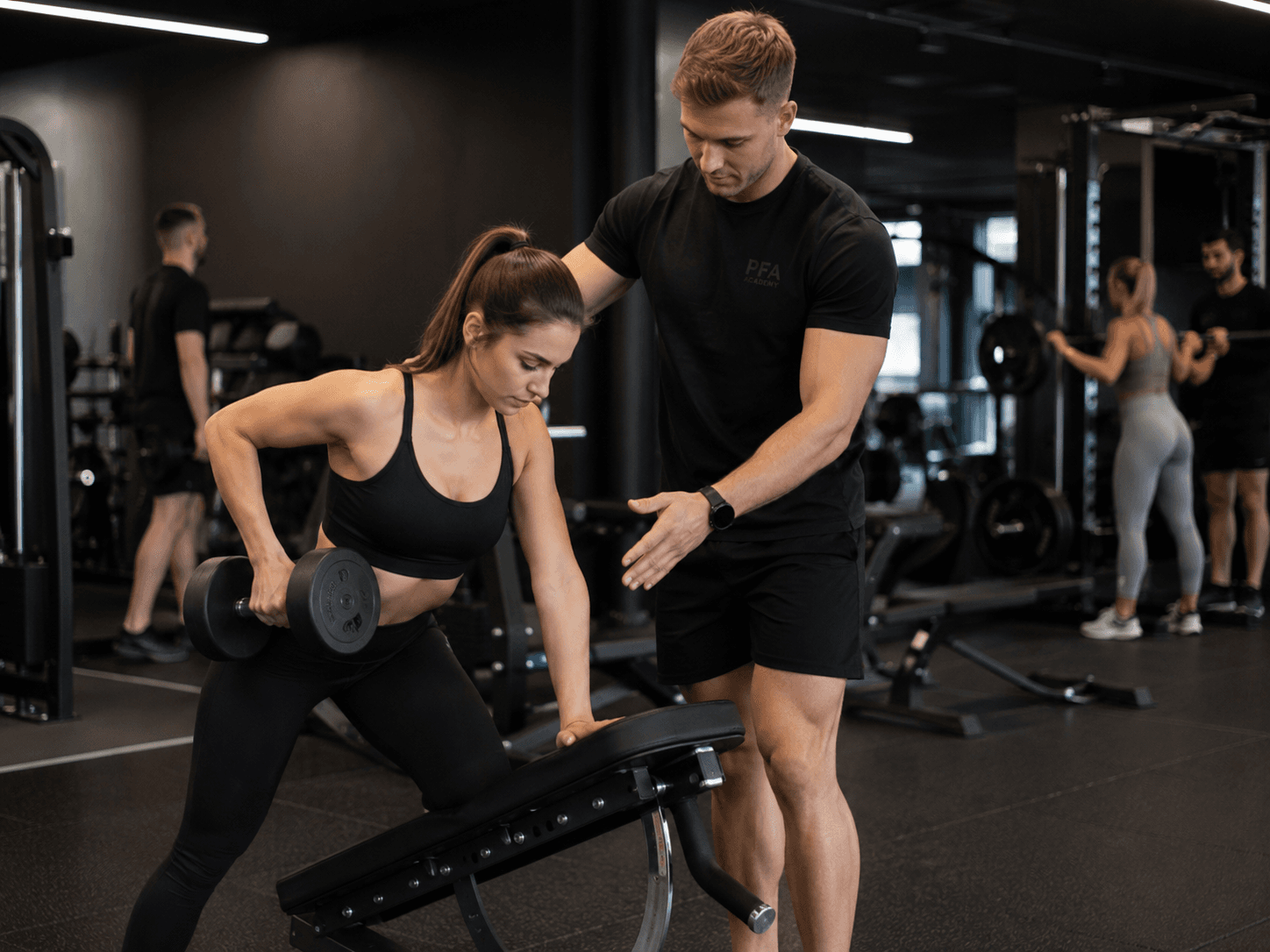
Perhaps you are thinking about a career change, developing your own services or taking your interest in fitness further. Becoming a personal trainer starts with understanding the role and choosing a clear learning path.
That path brings together knowledge of movement, exercise planning, communication and practical experience. A professional course can organise your learning, help you check your understanding and connect the topics you need to consider when working with clients.
This guide takes you through the main steps: understanding the profession, choosing your education, developing a client-focused approach, completing your assessment and presenting your skills professionally.
01
Understand what a personal trainer actually does
Personal training is about more than showing someone an exercise. It involves understanding a person’s goals, experience and circumstances, then organising a training process around them. Listening, explaining and reviewing progress are part of the role.
A client may need help making sense of a training plan, fitting sessions into a busy week or becoming more confident in the gym. Clear communication makes your knowledge useful: the person should understand what they are doing and why.
When planning your education, look for connections between exercise technique, anatomy, training principles, nutrition fundamentals and client communication. These subjects are most useful when you can bring them together in your decisions.
- Understanding movement and exercise technique
- Planning around a client’s goals and experience
- Learning nutrition fundamentals for healthy individuals
- Explaining instructions clearly and listening to feedback
- Reviewing progress and organising an ongoing training process
02
Choose an education path that fits your goals
A university degree and a professional course offer different learning experiences. Compare their syllabus, assessment, practical opportunities and time commitment in relation to the work you want to do. A clear programme helps you see what you will study and how your understanding will be assessed.
Before choosing a path, check the requirements for your intended role in the country where you plan to work, as well as those of prospective employers and insurers. This gives you a useful starting point for deciding which education and further training fit your plans.
Your learning can continue through practice, feedback and further study. Keep your services aligned with your training and experience, and build professional relationships with other specialists when a client needs support beyond your role.
03
Learn to coach people, not just to train yourself
Your own training experience gives you a useful perspective on consistency, effort and learning new movements. Working with another person adds a different challenge: their starting point, preferences and daily routine may be very different from yours.
For example, a plan that fits your week may not fit a client’s schedule. An explanation that makes sense to an experienced gym user may need to be simpler for someone unfamiliar with the equipment. Coaching means noticing those differences and adapting your approach.
Use your studies to practise explaining your reasoning. Why did you choose a particular approach? What information would you ask the client for? What would you review at the next session? Working through these questions helps connect knowledge with thoughtful decisions.
04
Use a course to build a structured learning path
Training information is easy to find, but deciding what to study and in which order takes more thought. Separate tips on exercise, nutrition and motivation do not automatically form a coherent education programme.
A well-organised personal trainer course gives your learning a sequence. You move through modules and lessons, revisit supporting materials, check your knowledge in quizzes and prepare for a final assessment.
Online learning can make that process easier to fit around work and other commitments. Set aside regular study time, make notes and return to topics that need more attention. The value comes from actively working through the programme, not simply reaching the last lesson.
05
Look for a programme that connects the key subjects
When comparing courses, look at the actual syllabus and learning process. Exercise knowledge, planning, communication and assessment should form a connected programme with a clear route to completion.
The PFA Academy Online Personal Trainer Course brings together 16 modules, 64 video lessons, downloadable learning materials, 16 module quizzes and a final exam. Completion of the course and passing the exam are documented by a certificate available in Polish and English, with a QR code for verification.
The programme also includes nutrition fundamentals for healthy individuals. Together with training principles and client communication, this gives you related topics to study within one organised course. Explore the programme before enrolling so you can connect its content with your learning goals.
- Anatomy and how the body works
- Exercise technique and understanding common mistakes
- Training plans and progression
- Nutrition fundamentals for healthy individuals
- Communication and the organisation of client work
- Module quizzes and a final exam
- A clear course completion and certificate verification process
06
Start training plans with the person and their goal
A training plan needs a reason behind it. Start with the person: what they want to work towards, their current experience, the time they can commit and the equipment available to them.
Someone returning to the gym after a break may have different priorities from someone preparing for a specific fitness goal. A useful plan reflects that context rather than copying a routine simply because it worked well for someone else.
Practise asking clear questions and recording the answers. What does the client want from the process? What have they tried before? What is realistic within their week? These conversations provide a basis for planning and reviewing the work together.
07
Develop clear explanations of exercise technique
A visually impressive workout is not the same as good coaching. Your client needs an approach they can understand and follow, with instructions that match their experience.
As you learn about technique, practise describing movements in straightforward language. Think about what you would observe, which point you would explain first and how you would check that the client understood you.
Combine study with appropriate practical experience and feedback. Written explanations, diagrams and learning notes can help organise your understanding; practising communication helps you turn that understanding into clear guidance.
08
Show the learning behind your certificate
A course completion certificate gives you a document you can use when presenting your educational background. Its meaning is clearer when the programme and assessment behind it are easy to understand.
At PFA Academy, the certificate confirms completion of the personal trainer course and passing the exam. The learning path connects lessons, materials, module quizzes and the final assessment before the document is issued.
When building your professional profile, explain the programme you completed and the subjects you studied. Present that education alongside your practical experience, approach to clients and continued development. This gives people more useful information than a certificate image alone.
09
Build your first steps around a clear offer
As your knowledge and experience develop, think about the people you would like to work with and how you will explain your service. A clear offer describes who it is for, how the cooperation works and what a client can expect from the process.
Prepare for conversations as well as training sessions. Practise introducing yourself, explaining your approach and listening to someone’s goals. Keep the way you present your experience and education accurate and easy to understand.
Your course, practical development and communication can then support one another. Keep reviewing what you have learned, seek useful feedback and take the next steps that fit the role and market you want to work in.
FAQ
Frequently asked questions
Do I need a degree to become a personal trainer?
No. A university degree is not the only route into personal training. Many people begin with a professional personal trainer course, practical experience and continued development. Check the requirements for the role and country where you plan to work, including any conditions set by prospective employers or insurers.
Is an online personal trainer course a good choice?
Yes. A professional online course can provide a complete, organised learning path with a clear programme, video lessons, downloadable learning materials, module quizzes, a final exam and a course completion certificate. It also gives you the flexibility to study at your own pace and return to the material whenever needed.
What should I learn first?
Begin with an understanding of the personal trainer’s role, movement and exercise technique, training principles and client communication. A structured course brings these areas together with anatomy, nutrition fundamentals for healthy individuals and assessment, so you can follow a clear sequence instead of collecting disconnected tips.
How can a certificate help when approaching potential clients?
A certificate strengthens your professional credibility by confirming that you completed a personal trainer course and passed the final exam. You can use it to present your educational background alongside your experience, explain how you work and build trust when introducing your service to prospective clients.
Summary
Make your next step a clear one
Choose a learning path that connects exercise knowledge, planning, nutrition fundamentals and communication. Work through the programme and assessment, develop your practical experience and present your education clearly. The PFA Academy Online Personal Trainer Course brings the learning stages together in one professional programme.
Explore the online course