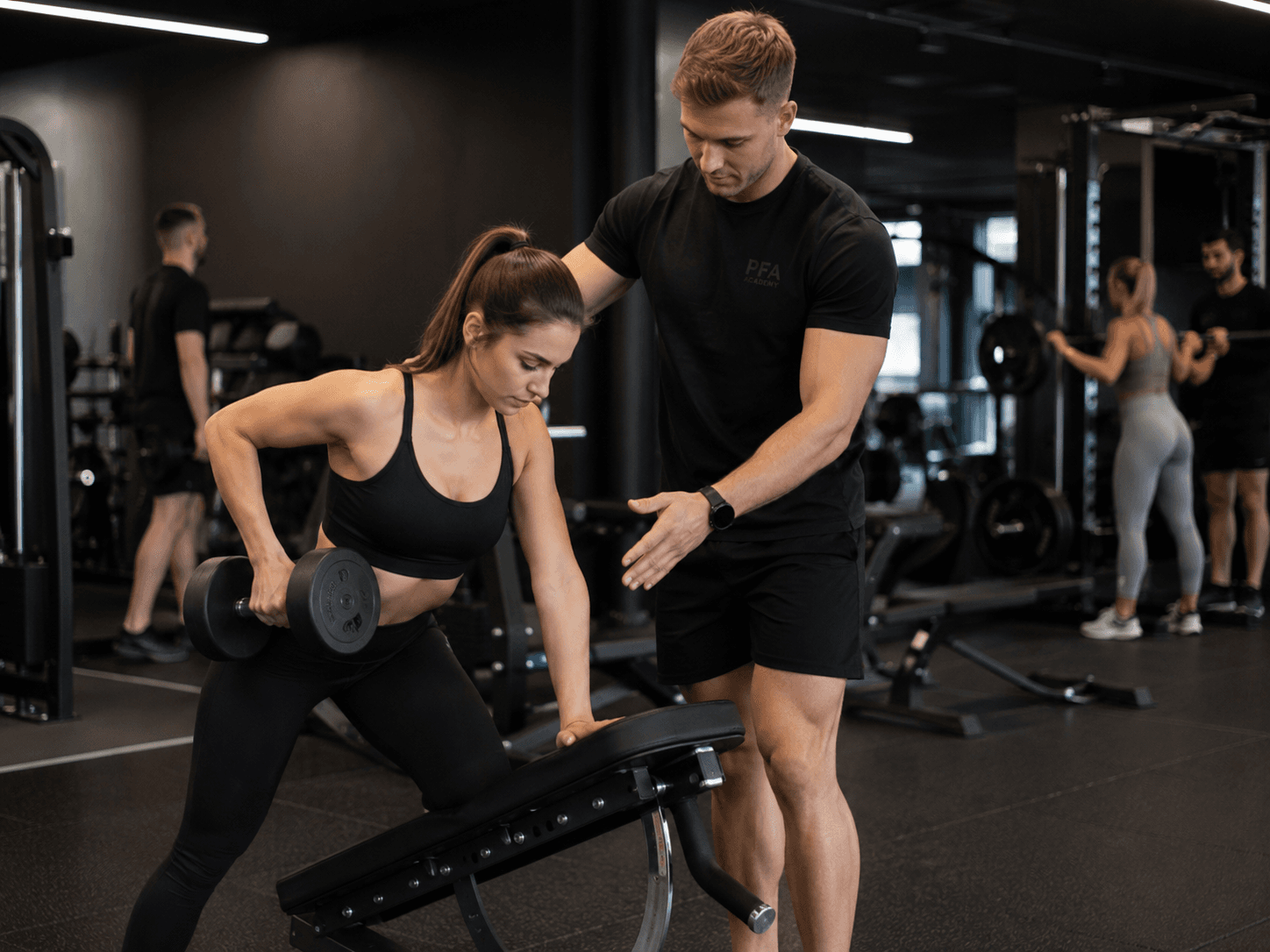
If you enjoy training and want to make fitness part of your professional life, university is one option to consider. It is not the only way to organise your education. A focused personal trainer course can help you study the subjects that matter for coaching while fitting learning around your existing work and commitments.
The useful question is not simply whether a degree is better than a course. It is which learning route suits the work you want to do, how the programme develops your knowledge and how you will apply that knowledge. A clear curriculum, meaningful assessment and regular practice give you specific steps to follow.
This guide explores the contribution of courses, university study, certificates and experience. It also explains how to present your education confidently and professionally, with an emphasis on the skills you develop rather than treating one educational background as the only valid choice.
01
Is a university degree compulsory?
Not in every setting. Routes into personal training can include professional training outside university. For example, England’s National Careers Service lists college courses, apprenticeships and specialist courses from private training organisations among the routes into the role. A university degree is therefore not a universal starting requirement.
For work elsewhere in Europe, check the requirements for the specific country and role you have in mind. Professional regulation differs between countries, and employers or insurers may set additional conditions. Your Europe, the EU’s official guidance service, explains how to check regulated professions and the relevant national authorities.
Once you understand that context, you can choose your education with a clear goal. A professional course can organise your learning around personal training, while a university programme may support a broader academic direction. The decision should reflect your intended work and the content of the programme, not just its label.
- Identify the personal training role and country you are planning for.
- Check the relevant entry requirements and any employer or insurance conditions.
- Compare the curriculum, assessment and learning format.
- Plan how you will develop and demonstrate practical coaching skills.
02
Education and practical experience work together
University study can develop understanding of subjects such as anatomy, physiology, biomechanics and exercise science. A personal trainer course focuses learning around the knowledge used in training and client support. In either format, it helps to connect each topic with a coaching decision you can explain.
Consider exercise selection. Knowing the name of a movement is different from understanding why you would choose it, how you would explain it and when you would adapt it. Studying those questions and then practising the relevant skills creates a stronger connection between learning and coaching.
That process continues throughout a training career. Observation, feedback, reflection and further education help you refine your approach. Practice is not something reserved for people without degrees: it is part of developing professional competence whatever educational route you choose.
03
What can a professional personal trainer course offer?
A professional course provides a defined learning path rather than leaving you to organise unrelated information yourself. Look for a published curriculum, a logical sequence of modules, useful learning resources and assessments that help you review what you have studied. These elements make the learning process easier to plan and follow.
PFA Academy’s online personal trainer course brings together 16 modules, 64 video lessons, downloadable educational materials, 16 module quizzes and a final exam. The programme covers subjects relevant to training, exercise planning, communication and working with clients. You can follow the sequence and return to individual topics as you progress.
Access has no time limit, so learning does not need to end when you finish the programme. After completing the course and passing the exam, you receive a certificate in Polish and English. The combination of organised study, review and documented completion gives your professional development a clear structure.
- 16 modules arranged into a defined learning path.
- 64 video lessons and downloadable educational materials.
- 16 module quizzes and a final exam.
- A certificate following course completion and a passed exam.
- Access to the course with no time limit.
04
How a course certificate supports your professional profile
A certificate gives you a clear way to document completed education. Alongside the programme description, it helps you explain what you studied and the assessment you completed. That is more informative than simply describing yourself as someone with an interest in fitness.
PFA Academy’s certificate confirms completion of the personal trainer course and passing the exam. It is issued in Polish and English and includes a certificate number and QR code for verification. These details make it straightforward to present the document and check its authenticity.
Use the certificate alongside an accurate description of your skills and experience. You can explain which topics you studied, how you organise training and how you continue developing. A professional profile becomes more useful when education and examples of your approach support each other.
05
Make your skills visible, not just your qualifications
A strong professional introduction answers practical questions: who do you work with, what does your service involve and how do you approach training? Education gives you important material for those answers. Clear communication helps another person understand how that knowledge relates to their goals.
When exploring a role at a fitness club, ask which qualifications and experience it expects. Prepare to discuss your learning, explain exercise choices and describe how you would organise a session. Specific examples make your preparation easier to assess than broad statements about being passionate about sport.
The same principle applies to your own service presentation. Describe your actual experience, your way of working and the education you have completed. A well-organised offer and clear explanations let you present your strengths without relying on titles alone or making promises you cannot substantiate.
06
Which subjects should your learning cover?
Whatever your previous education, it is useful to review the knowledge involved in personal training as a connected whole. Exercise technique, anatomy, programme design, communication and session organisation influence one another. A structured curriculum helps you see those connections instead of studying each topic in isolation.
For example, planning a session involves more than choosing exercises. You also need to understand the person’s goal, their training experience and how to explain the plan. Learning to observe, ask questions and review progress gives context to the technical material you study.
Use your learning resources actively. Summarise a topic in your own words, work through an example and note what you want to practise or clarify. Returning to the relevant lesson or material is a useful way to build consistency in your reasoning and prepare for further learning.
- Anatomy and the principles of human movement.
- Exercise technique and programme design.
- Goal-setting, session planning and reviewing progress.
- Clear instructions and communication with clients.
- General nutrition education and healthy habits within your role.
- Professional responsibilities and knowing when to refer to a specialist.
07
Professional judgement includes knowing your role
Good coaching includes recognising which questions belong within your training role and which need another professional’s expertise. This is part of responsible client care, not a measure of whether you studied at university or through another route.
A personal training course should not be presented as a qualification in medicine, physiotherapy or clinical dietetics. When a client needs assessment or treatment for a health concern, involve an appropriately qualified professional instead of making a diagnosis or promising a treatment yourself.
Clear boundaries help you describe your service accurately and build constructive working relationships. You can focus on the training you are competent to provide, communicate clearly and continue developing relevant skills. Professional confidence includes being clear about both your expertise and the support a situation requires.
08
When might university study suit your plans?
University may suit you if you want an extended academic programme, opportunities to explore research or a route towards a role with specific degree requirements. The relevant course content and entry requirements matter more than choosing a degree simply because it sounds connected to fitness.
Look closely at the programme you are considering: its subject areas, assessment, opportunities for practical work and the directions it supports. Sport science, physical education and health-related degrees have different aims. They should not be treated as interchangeable qualifications for every role involving exercise.
University study and professional courses can also complement each other. You can use focused training to develop a particular area of knowledge alongside a broader programme. The aim is to choose education that serves your goals, rather than create a competition between two different learning formats.
09
When might a focused course suit you better?
A focused personal trainer course can be a strong choice when you want organised education in training and client work, with a format that fits your current commitments. This can be particularly useful if you already train regularly, are considering a career change or want to formalise and extend your knowledge.
With an online format, you can plan study sessions around your own schedule. The value is not simply convenience: a clear sequence, repeat access to materials and regular knowledge checks help you maintain continuity. You have a programme to work through and resources to revisit.
Compare the complete offer before choosing. Review the modules, learning materials, exam, certificate and access terms together. PFA Academy presents these elements as one professional course, so you can see what is included and decide how the programme fits your development plans.
10
Present your education with confidence
If your route does not include a university degree, you can still describe your education positively and precisely. Name the course you completed, explain its subject areas and state the exam you passed. Add your actual experience and the areas you are continuing to develop.
Keep the emphasis on useful information. Instead of comparing yourself with people from a different educational background, explain how you approach training and what a client can expect from your service. Clear language and concrete details create a more convincing introduction than exaggerated claims.
A professional learning path is something you build over time. A course, its certificate, practical experience and further study each contribute to that path. Choose the next step that fits your goals, give it consistent attention and make the knowledge you gain part of how you work.
FAQ
Frequently asked questions
Do you need a degree to become a personal trainer?
No. A university degree can be valuable, but it is not the only route into personal training. Many people begin with a professional personal trainer course, practical experience and continued development. Check the requirements for your intended role and country, including any conditions set by an employer or insurer.
Can I develop personal training skills without university study?
Yes. A structured personal trainer course can give you a strong foundation in training, programme design and client communication. Combine organised study with practical experience, feedback and continued learning to build the skills and confidence needed for responsible work with clients.
Can a personal trainer course be a strong starting point?
Yes. A good course can be a strong professional starting point when it includes a clear curriculum, organised modules, learning materials, knowledge checks, a final exam and a certificate. PFA Academy includes 16 modules, 64 video lessons, downloadable materials, 16 module quizzes and access with no time limit.
Is a course certificate more useful than a university degree?
They serve different purposes. A course certificate confirms completion of a defined professional training programme and its assessment, while a degree confirms university study. The better choice depends on your goals, the role you want to pursue and the knowledge and practical preparation offered by each path.
Summary
Choose the learning route that fits your professional goals
University is one educational option, not the only way to develop personal training knowledge. A professional course gives you an organised programme, assessment and documented completion, with practical experience and further learning supporting your development. Check the requirements where you plan to work, compare the complete curriculum and choose a route you can follow consistently. Explore PFA Academy’s online course to see its modules, learning resources, exam and certificate in one place.
Explore the online course